
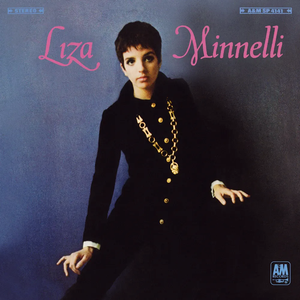
"Liza Minnelli" is the fourth studio album by American singer and actress Liza Minnelli, and it marks her first release with A&M Records.
Despite receiving critical acclaim for her previous albums, her releases with Capitol Records, with the exception of "Liza! Liza!," were not commercially successful. Her contract with Capitol Records was not renewed, and during that period, Minnelli had not yet achieved the superstar status she would later attain. In the summer of 1967, she signed a contract with A&M Records and would release her first album in 1968.
Recording sessions for the album took place between October 14 and December 1967. The album was produced by Larry Marks and arranged by Peter Matz, Nick de Caro, Bob Thompson, and J. Hill. The sound engineers were Ray Gerhardt, Donald Hahn, and Peter Matz. The album's design was by Corporate Head, with art direction by Tom Wilkes and photography by Guy Webster.
For the new repertoire, Minnelli recorded songs by contemporary artists and moved away from the Great American Songbook classics for which she was known. This change in direction was not only a desire of the record label but was also influenced by Larry Marks and composer Peter Allen, both of whom were impressed by the work of Randy Newman, with whom Allen had a strong affinity.
Among the songs recorded during the "Liza Minnelli" sessions but not included in the final release were "Snow," "No One Ever Hurt So Bad," and "Hong Kong Blues." Four tracks were found on an A&M tape labeled "1968," including "I'm Looking Over A Four Leaf Clover," "Alicinha," "I'll Never Fall In Love Again," and "This Girl's In Love With You." These tracks were included in the compilation "The Complete A&M Recordings."
Before the album's release, Minnelli conducted interviews and performed on various TV shows and events. According to Billboard magazine editor Aaron Stenfield, she performed at the Wardorf-Astoria's Empire Room, singing three songs from "Liza Minnelli": "The Debutante's Ball," "You Better Sit Down Kids," and "The Happy Time." Her performance made a positive impression on the magazine's editor, who wrote that if the album could capture any part of the excitement that Miss Minnelli generates personally, A&M would have a valuable property.
Billboard announced the album's release for March in its March 9, 1968 edition. In Sydney, Australia, the record label planned to coincide the album's release with Minnelli's live shows at the Chequers club.
During the promotion, she appeared on several American TV programs, including "The Ed Sullivan Show," "The Tonight Show," "The Hollywood Palace," and "The Carol Burnett Show."
Music critics' reviews were mostly favorable. A Record World magazine critic wrote that "Liza adopted the light and relaxed style of the summer label, showing herself smooth and fresh rather than bold." He considered the songs "The Happy Time" and "The Look of Love" wonderful.
JT Griffith of the AllMusic website gave the album three out of five stars and wrote that the album is an energetic collection that captures a vibrant artist in a solid set of songs. He noted that the repertoire mixes Broadway numbers with material from contemporary singer-songwriters.
The Billboard magazine critic wrote that Minnelli sounded like her mother, singer, and actress Judy Garland, and this was a good thing. He stated that three songs stood out on the album: "The Look of Love," "(The Tragedy Of) Butterfly McHeart," and "The Happy Time."
Rex Reed from HiFi Stereo Review magazine gave a favorable review, writing that the album "is a lesson in sensitive lyrical communication" and "simply marvelous." He stated that Minnelli's voice on the recording was better than ever, filled with joy and gentle splendor, melancholic innocence, and hints of sarcasm and mature elegance.
Cash Box magazine also gave a favorable review, declaring Minnelli's first album with A&M a victorious entry. They selected "The Debutante's Ball," "The Look Of Love," "You'd Better Sit Down, Kids," and "The Happy Time" as the album's standout moments.
Morgan Ames of High Fidelity magazine wrote that the album was a pleasant surprise, especially considering Minnelli's soft singing style. He noted that many critics believed Minnelli's voice would not last long due to the deplorable state and disastrous intonation in her performances throughout her career. However, the album proved them wrong. He concluded that Minnelli seemed to be finding a better focus on what she wanted to sing and that her vocals were great except when she "shouts" in songs.
HiFi Stereo Review magazine named it the best album of 1968, and Minnelli received the award from editor William Anderson and critic Rex Reed.
Commercially, the album failed to chart on the Billboard 200.
This User-contributed text is available under the Creative Commons By-SA License; Source: Last.fm.