
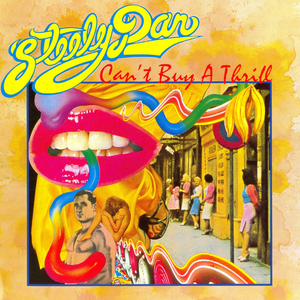
“Can't Buy a Thrill” is the debut studio album by American rock band Steely Dan, released in November 1972 by ABC Records. It was written by band members Walter Becker and Donald Fagen and recorded in August 1972 at the Village Recorder in Los Angeles with producer Gary Katz. The album is stylistically diverse, incorporating elements of soft rock, pop rock, and jazz rock, along with lyrical themes that are often abstract and philosophical in nature.
The album was a commercial success, peaking at number 17 on the US Billboard Top LPs & Tape chart. It was supported by the singles “Do It Again” and “Reelin' In the Years” and was later certified platinum by the Recording Industry Association of America (RIAA). It received generally positive reviews and has appeared on various retrospective rankings of notable albums, including Rolling Stone magazine’s “500 Greatest Albums of All Time” (2003).
After the band’s debut single “Dallas” was withdrawn as not representative of their style, ABC Records proceeded with plans for an album recording. Sessions originally scheduled for summer 1972 were postponed until engineer Roger Nichols returned from vacation, as the band considered his involvement important. This delay caused some tension with ABC Dunhill president Jay Lasker, although A&R representative Steve Barri supported the band’s decision. Material for the album included newly written songs and earlier compositions from Becker and Fagen’s pre-Los Angeles period, including “Midnite Cruiser”, “Fire in the Hole”, and “Brooklyn (Owes the Charmer Under Me)”. A comparison with earlier demo versions of “Brooklyn (Owes the Charmer Under Me)” indicates structural changes in the album version, including the removal of a verse and a change in the introductory instrumentation.
Recording took place in August 1972 at the Village Recorder in Los Angeles. All songs were written by Walter Becker and Donald Fagen, though the liner notes credit “Do It Again” as a traditional song, a designation later understood as not reflecting its actual authorship. At the time of recording, Steely Dan functioned as a five-member band, with Fagen performing most lead vocals. Drummer Jim Hodder sang lead vocals on “Midnite Cruiser”, which was accepted by Becker and Fagen. Four songs recorded during the sessions were not included on the album: “Running Child”, “Sacajawea”, “Megashine City (Talkin' About My Home)”, and “Gullywater”. None of these tracks were officially released on the album or its singles, although “Running Child” was later recorded by Christopher Kearney for his 1975 album “Sweet Water”.
During production, discussions arose regarding live touring in support of the album, which the band had not initially anticipated, as Becker and Fagen had considered Steely Dan potentially a studio-focused project. Concern was expressed by Fagen about performing lead vocals live. As a result, David Palmer was recruited as an additional lead vocalist, with producer Gary Katz reportedly expressing reservations about the decision. Palmer contributed lead vocals to “Dirty Work” and “Brooklyn (Owes the Charmer Under Me)” and added backing vocals to several other tracks.
Musically, “Can't Buy a Thrill” has been described as featuring a soft rock foundation with influences from mambo, swing, jazz, and Latin styles. Critics have noted that the album contains fewer of the jazz-oriented elements that would later become more prominent in Steely Dan’s work, although songs such as “Do It Again” incorporate Latin-influenced rhythmic structures, and “Reelin' In the Years” includes prominent guitar work and harmonized arrangements. The album has also been described as a transitional work in which the band was still developing its distinctive musical identity, with a mix of rock-oriented tracks, ballads, and rhythmically varied compositions.
“Do It Again” has been described by critic Robert Christgau as a mambo-influenced track with lyrics depicting themes of repetition and personal failure. It is also considered harmonically simple relative to later Steely Dan compositions. “Dirty Work” is the only track on the album featuring horn instrumentation and demonstrates the band’s early use of harmonic structures that move outside the home key. “Kings” references historical events surrounding the death of King Richard I of England and the subsequent succession of King John; guitarist Elliott Randall has stated that his solo on the track was influenced by personal emotional experiences at the time. “Fire in the Hole” includes piano-driven arrangements and references Vietnam War-era terminology, while also alluding to draft avoidance during that period. “Brooklyn (Owes the Charmer Under Me)” is based on an imagined narrative about a tenant living beneath Donald Fagen’s apartment in Brooklyn. “Turn that Heartbeat Over Again” is structured as a multi-section composition with key changes and extended form.
The album title “Can't Buy a Thrill” is commonly interpreted as a reference to a line from Bob Dylan’s song “It Takes a Lot to Laugh, It Takes a Train to Cry”, although Donald Fagen has also attributed it to a remark by Walter Becker. Several concepts were considered for the album cover before the final design was selected. Early ideas included a staged photograph involving a child outside a pornography shop and an image inspired by the film “Irma la Douce”, but both were abandoned. The final cover is a photomontage created by Robert Lockart, featuring composite imagery including figures such as bodybuilders and depictions of prostitutes in a street scene in Rouen, France. The band reportedly disliked the final cover, though time constraints led to its use. Becker and Fagen later commented that the cover of their 1976 album “The Royal Scam” was also considered among their least favored designs, alongside “Can't Buy a Thrill”. The cover of “Can't Buy a Thrill” was reportedly banned in Francoist Spain and replaced with an alternative image showing the band performing live.
This User-contributed text is available under the Creative Commons By-SA License; Source: Last.fm.