
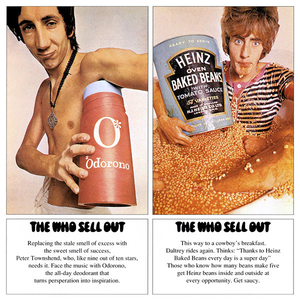
“The Who Sell Out” is the third studio album by the English rock band The Who. It was released on 15 December 1967 by Track Records in the UK and Decca Records in the US. It is a concept album structured as a sequence of songs interspersed with fictional radio commercials and public service announcements, including “Heinz Baked Beans”. The album is presented as a broadcast from pirate radio station Radio London. The theme of “selling out” was intended as irony, as The Who had also recorded real commercial jingles during the same period, some of which were later included as bonus tracks on reissues.
Most of the material was written by guitarist Pete Townshend, with three songs written by bassist John Entwistle and one contributed by guest vocalist Speedy Keen, who also performs lead vocals on that track. The core lineup of Roger Daltrey, Pete Townshend, John Entwistle, and Keith Moon is joined by guest organist Al Kooper on two tracks. The album was produced by the band's manager Kit Lambert.
Following its release, the album reportedly prompted legal and commercial disputes due to its use of real brand names in parody advertisements and on the cover artwork. Radio London jingles, produced by PAMS Productions, were also claimed to have been used without permission. The deodorant company Odorono objected to its inclusion in promotional material. “I Can See for Miles” was the only single released from the album and reached number 10 in the UK and number 9 in the US, becoming The Who's highest-charting single in the United States.
“The Who Sell Out” received strong critical acclaim and is often considered one of The Who's best albums. It has appeared on several lists of the greatest albums of all time, including Rolling Stone's “The 500 Greatest Albums of All Time”. Despite this, it was the band's lowest-charting album in the UK, peaking at number 13.
The album was originally intended to follow “A Quick One” under the title Who's Lily, referencing the single “Pictures of Lily”. Early recordings included material such as “Summertime Blues”, Coca-Cola jingles, and the instrumental “Sodding About”, which reflected the influence of Jimi Hendrix on Townshend's guitar work.
The members of The Who were heavily influenced by radio during their early development, particularly pirate stations such as Radio Caroline, Radio Scotland, and Wonderful Radio London, since the BBC played limited contemporary popular music. By 1966, the band had achieved commercial success through the mod subculture and appearances on television programmes such as “Ready Steady Go”, although that movement was declining by the following year. The band also began to gain recognition in the United States through live performances.
In 1967, manager Kit Lambert and Chris Stamp proposed a concept album structured like a pirate radio broadcast or American AM radio station, incorporating music alongside advertising-style interludes. Various accounts attribute the concept to different individuals within the band's circle. The introduction of the Marine, &c., Broadcasting (Offences) Act 1967, which effectively ended most British pirate radio broadcasting, further reinforced the album's concept as a tribute to that era.
Recording sessions took place across multiple studios in London, New York, and Nashville between April and November 1967. Early sessions at De Lane Lea Studios included material intended for an instrumental EP, such as “In the Hall of the Mountain King” and “Instrumental No-Title”, later retitled “Sodding About”. Coca-Cola jingles including “Coke after Coke” and “Things Go Better With Coke” were also recorded.
Subsequent sessions produced a wide range of material, including “Armenia City in the Sky” by Speedy Keen, “I Can See for Miles”, and early versions of songs such as “I Can't Reach You”, “Relax”, and “Rael”.
This User-contributed text is available under the Creative Commons By-SA License; Source: Last.fm.