
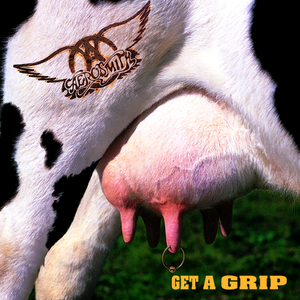
"Get a Grip" is the eleventh studio album by American rock band Aerosmith, released in April 1993 by Geffen Records. It was Aerosmith's final studio album released by Geffen before the band returned to Columbia Records.
The album features guest appearances by Don Henley, who provided backing vocals on "Amazing", and Lenny Kravitz, who contributed backing vocals and collaborated on "Line Up". As with "Permanent Vacation" and "Pump", the album involved numerous outside songwriters and collaborators, including Desmond Child, Jim Vallance, Mark Hudson, Richie Supa, Taylor Rhodes, Jack Blades, and Tommy Shaw.
"Get a Grip" became Aerosmith's best-selling studio album worldwide, with reported sales of more than 20 million copies. It was the band's first album to reach number one in the United States and, along with "Pump", became its second-best-selling album in the country, with more than seven million copies sold by 1995. "Toys in the Attic" remained the band's best-selling album in the United States, with nine million copies sold. "Get a Grip" was also Aerosmith's third consecutive album to achieve US sales of at least five million copies. Two songs from the album received Grammy Awards for Best Rock Performance by a Duo or Group with Vocal, in 1993 and 1994. The album was named Album of the Year in Metal Edge's 1993 Readers' Choice Awards, while "Livin' on the Edge" was named Best Video.
The album originally contained 12 songs and was scheduled for release in the third quarter of 1992. After Geffen A&R executive John Kalodner heard the recorded material, he considered it lacking in variety and a radio-friendly song. Aerosmith subsequently returned to the studio to write and record additional material with outside collaborators, including Desmond Child. "Get a Grip" was the final Aerosmith album produced by Bruce Fairbairn, who died in 1999.
Several songs on the album address aspects of Aerosmith's history with drug abuse. Discussing "Get a Grip" and "Amazing", Steven Tyler said that the songs drew comparisons between drug use and traditional ideas about making a pact with the devil, describing drug use as something that could initially be enjoyable but eventually carried consequences.
A number of songs recorded during the sessions were subsequently released as B-sides or on later editions of the album. "Don't Stop" and "Head First" appeared as B-sides, while "Can't Stop Messin'" was also included on several special editions of "Get a Grip". Alternate versions of "Deuces Are Wild", "Lizard Love", "Devil's Got a New Disguise", and "Legendary Child" were later released on various albums and soundtracks.
Additional songs were listed on Aerosmith's official website during the late 1990s, including "Black Cherry", "Dime Store Lover", "Meltdown", "Rocket 88", "Wham Bam", and "Yo Momma". In 2005, Kalodner confirmed the existence of several of these songs, as well as "Trouble", "Strange", "13", and "Keep on Movin'". "Deuces Are Wild" may also have been recorded again during the sessions. Other songs associated with the sessions through copyright repertoires include "Ain't Gonna Break My Heart", "Good Thang", and "Jake". These songs have been associated with recordings dating from 1991.
The cover of "Get a Grip", designed by album-cover artist Hugh Syme, depicts a cow with a captive bead nipple ring through its udder and an Aerosmith logo branded onto its body. Music critic Steven Hyden described the cover as "the worst album cover ever", while noting the contrast with Syme's other work. An animal-rights organisation objected to the image, although Aerosmith stated that it had been digitally altered and did not depict actual animal cruelty.
A special edition of the album was issued in a fabric-covered case designed to resemble cowhide.
On June 27, 1994, Aerosmith became the first major recording artist to release a song exclusively as a digital download when "Head First" was made available as a 4-megabyte WAV file to CompuServe subscribers. Approximately 10,000 users downloaded the song during its first few days of availability. At the time, most CompuServe users accessed the service through modems, making the download process relatively lengthy. "Head First" had previously been released as the B-side of "Eat the Rich".
Contemporary critical reception to "Get a Grip" was mixed. Mark Coleman of Rolling Stone praised the title track and compared the album's opening track with Aerosmith's 1986 collaboration with Run-D.M.C. on "Walk This Way", but considered much of the remaining material less adventurous and criticised what he viewed as a sombre tone and the involvement of outside songwriters. Stephen Dalton of New Musical Express similarly noted the more serious themes and the album's numerous collaborations. Robert Christgau gave the album a more favourable assessment, describing it as broadly consistent with Aerosmith's established musical approach and highlighting "Cryin'" as its strongest track. He considered "Livin' on the Edge" the closest thing to a weak track while acknowledging its potential as a hit.
Later reviews also varied. Stephen Thomas Erlewine of AllMusic considered "Get a Grip" less musically diverse than "Pump" and criticised what he perceived as a lack of spontaneity. Martin Popoff described the album as consisting largely of strong and professionally executed songs. Brian Cogan and William Phillips, writing in "Encyclopedia of Heavy Metal Music", viewed the album as a continuation of the commercially successful approach Aerosmith had developed beginning with "Permanent Vacation", noting that the use of professional songwriters contributed to the band's commercial success while reducing some of the rawness associated with its 1970s work. In his 2025 book "Aerosmith: Every Album, Every Song", Andrew Rooney described Aerosmith's decision to continue with this established formula as a bold choice given the growing popularity of alternative rock between the releases of "Pump" and "Get a Grip".
This User-contributed text is available under the Creative Commons By-SA License; Source: Last.fm.