
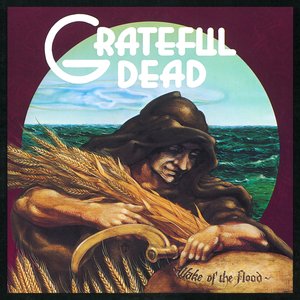
Wake of the Flood is the sixth studio album (and tenth album overall) by the rock band the Grateful Dead. Released on October 15, 1973, it was the first album on the band's own Grateful Dead Records label. Their first studio album in nearly three years, it was also the first without founding member Ron "Pigpen" McKernan, who had recently died. His absence and keyboardist Keith Godchaux's penchants for bebop and modal jazz (rather than McKernan's tendencies toward the blues and rhythm and blues) contributed to the band's musical evolution. Godchaux's wife, vocalist Donna Jean Godchaux, also joined the group and appears on the album.
The release fared better on the pop charts than their previous studio album (1970's American Beauty), reaching No. 18. An expanded version was released in 2004.
After three (official) live albums in a row, the Grateful Dead wanted to record studio versions of songs written since Keith Godchaux had joined the band. At the time of recording, five of the songs on the album (and part of a 6th) had been in live rotation for up to a year and a half, as arrangements were road-tested and finalized. Referring to this period, bassist Phil Lesh explained, "We'd learned to break in the material at shows (under fire, as it were), rather than try to work it out at rehearsals, or in the studio at tremendous expense."
The new compositions drew on many of the band's influences, blending genres from country folk and R&B to ragtime and jazz rock, the latter being more prominent than previously. As had become routine, Robert Hunter and Jerry Garcia wrote the majority of the songs; Bob Weir contributed the epic "Weather Report Suite" with lyrics by John Perry Barlow. The "Prelude" section of this piece had been developed onstage, but the "Part 1" and "Part 2 (Let it Grow)" debuted after the album's recording. "Let Me Sing Your Blues Away" is the band's only singing-songwriting contribution from Keith Godchaux. It was performed live just six times, in September 1973, between the recording and release of the album.
Describing Godchaux's influence, drummer Bill Kreutzmann characterized the album as "Keith's coming out party." Remarking on the evolution in style, he remembered:
"Jerry brought "Row Jimmy" into us one day, and it was really difficult to get a grip on it at first. It has a slow tempo, which makes it seem like it would be easy, but it calls for a slight reggae groove layered over a ballad. Rhythmically, the lengths aren't traditional. They're not just twos and fours. It's deceiving. Basically, you have to play the song in half-time with a double-time bounce on top. It's trickier than it sounds. But once I locked into it, "Row Jimmy" became one of the best songs in our repertoire."
The band chose to record at the recently built Record Plant between August 4–15, 1973. It was in Sausalito, near their San Rafael home base, and had been used by cohorts New Riders of the Purple Sage for their successful album The Adventures of Panama Red (which featured input from Hunter and Donna Godchaux). Staff engineer Tom Flye, assistant engineer Tom Anderson, and Dead soundman Dan Healy recorded and mixed on 24-track, bringing the mixdown to Lacquer Channel in Sausalito for mastering. The initial vinyl runs were pressed by Monarch Record Mfg., in Los Angeles.
A 50th Anniversary Edition of Wake of the Flood, remastered from the original recording, is scheduled to be released on September 29, 2023. The CD version includes two bonus tracks – demo recordings of "Eyes of the World" and "Wake of the Flood" – and a bonus disc recorded live at McGaw Hall in Evanston, Illinois on November 1, 1973. The digital download version, in ALAC or FLAC format, has the same tracks as the two-disc CD. The LP version, on black or colored vinyl or as a picture disc, has the same tracks as the original album.
This User-contributed text is available under the Creative Commons By-SA License; Source: Last.fm.