
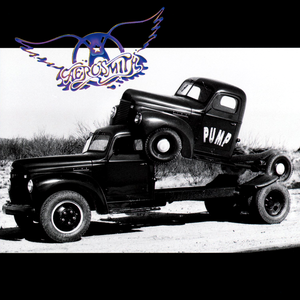
"Pump" is the tenth studio album by the American rock band Aerosmith. It was released on September 12, 1989, by Geffen Records. The album reached number five on the US Billboard 200 and was certified seven-times platinum by the Recording Industry Association of America (RIAA) in 1995.
The album produced four singles that reached the Top 40 of the Billboard Hot 100: "Love in an Elevator", "The Other Side", "What It Takes", and "Janie's Got a Gun". It has been certified for sales of seven million copies in the United States, making it, alongside its successor "Get a Grip", Aerosmith's second-best-selling studio album in the country, behind "Toys in the Attic", which has been certified for nine million copies. "Pump" produced several notable achievements for the band, including Aerosmith's first Grammy Award, which was awarded for "Janie's Got a Gun". "Love in an Elevator" was the band's first song to reach number one on the Mainstream Rock Tracks chart. The album was the fourth-best-selling album of 1990.
In the United Kingdom, "Pump" was the second Aerosmith album to be certified Silver by the British Phonographic Industry, receiving the certification in September 1989 for sales of 60,000 units.
"Pump" was the second of three consecutive Aerosmith albums recorded with producer Bruce Fairbairn and engineers Mike Fraser and Ken Lomas at Little Mountain Sound Studios.
Two video documentaries about the recording of the album, "Things That Go Pump in the Night" and "The Making of Pump", were released on VHS and LaserDisc in 1990. "The Making of Pump" was also released on DVD in 1997.
In December 1988, Aerosmith assembled at Rik Tinory Productions in Cohasset, Massachusetts, to rehearse and write new material. The band believed that the isolated location would encourage creativity. More than 19 songs were written and divided into an "A-list", consisting of songs considered potential hits such as "Love in an Elevator" and "What It Takes", and a "B-list" of less-developed material such as "Voodoo Medicine Man". Producer Bruce Fairbairn emphasised the use of hooks throughout the songs.
Several songs considered for the album were not released in their original forms, including "Girl's Got Somethin'", "Is Anybody Out There", "Guilty Kilt", "Rubber Bandit", "Sniffin'", and "Sedona Sunrise". Several songs also had alternative working titles. For example, "Voodoo Medicine Man" was originally titled "Buried Alive" and "News for Ya Baby". The working titles and other unreleased songs were documented in photographs of the studio's whiteboard and footage from "The Making of Pump".
In January 1989, the band travelled to Vancouver to record at Little Mountain Sound Studios with Fairbairn, who had previously produced Bon Jovi's "Slippery When Wet" and "New Jersey". Aerosmith recorded at the studio while Mötley Crüe was working on its album "Dr. Feelgood". Steven Tyler and the Margarita Horns, Aerosmith's horn section, subsequently contributed backing vocals and instrumentation to several tracks on that album. During the vocal sessions, the sound of Mick Mars' guitar entered the recording room from an adjacent room because of the volume of his amplifiers.
The album was intended to have a rawer sound than "Permanent Vacation", which the band felt had been produced with a more commercial approach. Joe Perry said that the band wanted to remove some of what it considered unnecessary elements from its previous album and did not set out to include songs dealing with particular subjects, although such themes were used when they suited the material. This approach contributed to the use of instrumental interludes between songs. The interludes were recorded with musician Randy Raine-Reusch, who was brought to the studio after Perry and Tyler visited his home to look for unusual instruments. Many of the lyrics deal with sexual themes, which Tyler attributed to compensating for time spent using drugs instead of having sex during the 1970s.
During a 1989 MTV special titled "Aerosmith Sunday", Brad Whitford explained the album's title by referring to the band's recovery from drug use.
Tyler later expressed regret that the album booklet did not contain the lyrics. According to him, Geffen Records had been concerned that the Parents Music Resource Center would object to the album's references to sex and drugs. The lyrics were subsequently included in the tour programme. The album cover features a black-and-white photograph of a smaller International K Series truck positioned on top of a larger International KB Series truck, with both cargo beds removed. The International markings on the truck hoods were replaced with the letters "F.I.N.E.", an acronym for "Fucked Up, Insecure, Neurotic, and Emotional", as stated in the album's liner notes.
Aerosmith was involved in a lawsuit after a small rock band named Pump sued the band's management company for service mark infringement. Aerosmith prevailed in the case.
The band also faced legal action from the songwriting team Holland-Dozier-Holland, which alleged that the main melody of "The Other Side" was similar to that of "Standing in the Shadows of Love". The dispute was settled with Aerosmith agreeing to credit Holland-Dozier-Holland as songwriters on "The Other Side".
"Pump" received generally positive reviews from music critics. Critics frequently noted its hard rock-oriented sound compared with the pop-metal characteristics of "Permanent Vacation". The album has subsequently been described as a significant release of the glam metal era and as comparable with Aerosmith's work from the 1970s.
Q described the album as the best metal album of 1990. Rolling Stone highlighted its hard rock sound and several of its songs, including "Young Lust", "My Girl", and "Janie's Got a Gun". Robert Christgau praised the album's first side while expressing a preference for "Janie's Got a Gun".
Spin ranked "Pump" at number 279 on its list of "The 300 Best Albums of the Past 30 Years". The album was also included in the book "1001 Albums You Must Hear Before You Die".
Loudwire ranked "Pump" fourth among Aerosmith's albums, noting its combination of contemporary 1980s hair metal production and elements associated with the band's earlier sound.
This User-contributed text is available under the Creative Commons By-SA License; Source: Last.fm.